
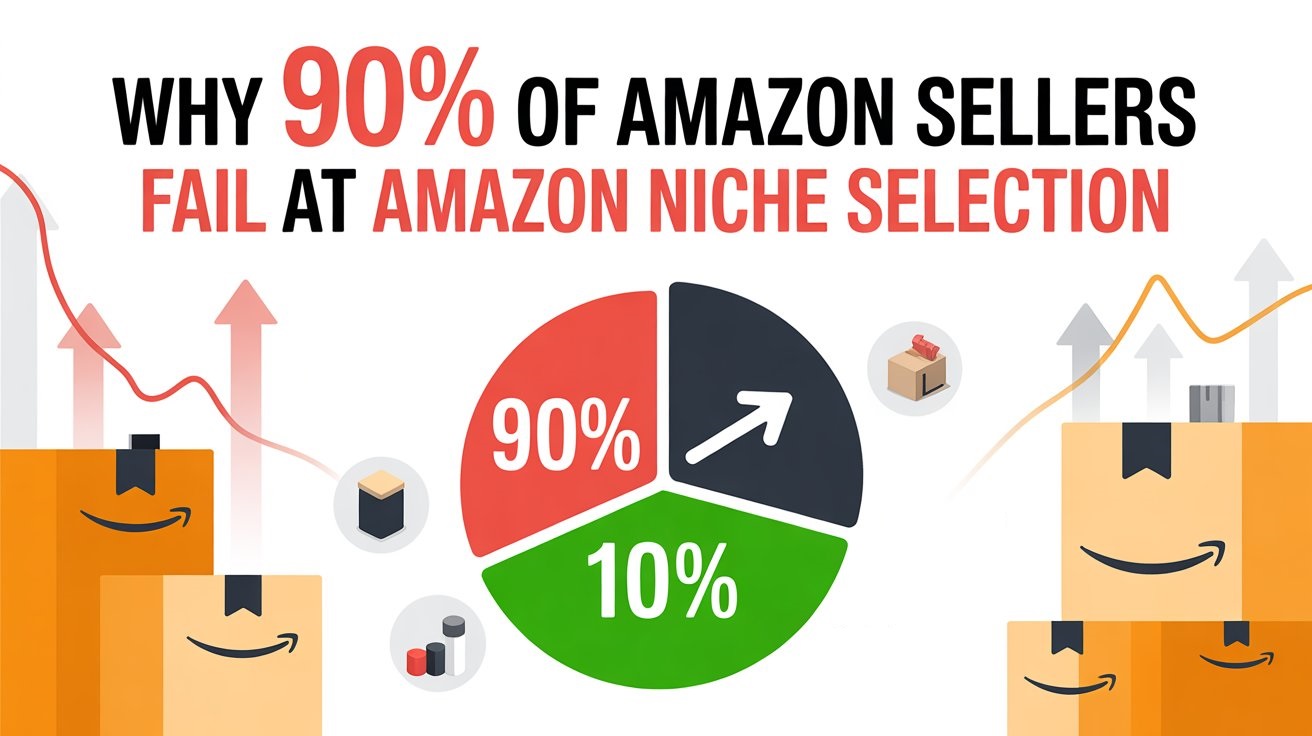
The Silent Reason Most Amazon Stores Never Grow
Many Amazon sellers blame ads, suppliers, or listing quality when sales stay flat. In reality, the real problem appears much earlier.
Amazon niche selection decides success before a product ever launches.
Sellers often jump into products that look popular on Amazon best sellers pages or social posts. These products already face strong sellers, high review counts, and price pressure. Once inventory arrives, ads cost more than expected and sales slow down.
This happens to private label sellers, FBM sellers, wholesalers, and even Amazon service providers who advise clients without solid research systems.
Amazon niche selection is not about picking what sells most. It is about picking what still has space.
What Amazon Niche Selection Really Means in 2026
A niche is not a single product. It is a focused buyer group with repeat demand and room for new sellers.
A strong niche market Amazon sellers aim for usually shows:
- Steady buyer searches
- More than one product angle
- Review counts that new sellers can reach
- Pricing that leaves margin after fees
Many sellers confuse Amazon niche products with trending items. Trends fade. Niches last.
Why Most Sellers Fail at Amazon Niche Selection
Copying Amazon Best Sellers Without Context
Amazon best sellers pages show what already won. These pages do not show how hard it was to get there.
Most top listings have:
- Years of reviews
- Strong supplier deals
- Mature brand trust
New sellers entering these spaces face pressure from day one.
Trusting Guesswork Instead of Product Research Amazon Data
Many sellers rely on feelings, videos, or forum posts. This leads to poor decisions.
Without real numbers, sellers miss signals like:
- Review concentration
- Sales spread across brands
- Price stability
Good niche product finder tools exist because guesswork fails.
Confusing High Demand With Low Risk
High demand also attracts more sellers. A niche with moderate demand and weak competition often performs better than a crowded high-demand space.
This mistake shows up often in Amazon niche selection free methods that skip data checks.
The Role of Data Tools in Better Niche Decisions
Strong niche research depends on clean data. This includes search demand, seller strength, and lead sources.
This is where research tools and scraping tools support smarter choices.
Why Maps Scraping Matters in Amazon Research
Many sellers think maps scraping only helps local businesses. That view misses a big opportunity.
Maps scraping tools collect business data such as:
- Supplier contacts
- Brand owners
- Local manufacturers
- Service partners
For wholesalers and service providers, this supports faster outreach without random searching.
Why Verified Email and Phone Data Matter
Bad contact data wastes time and hurts outreach results.
Verified email and phone data help sellers:
- Contact brand owners for wholesale
- Reach suppliers directly
- Offer services to active sellers
Clean data improves response rates and avoids blocked accounts.
Why Businesses Use Maps Scrapers for Lead Generation
Amazon sellers do not work alone. They rely on suppliers, prep centers, designers, and logistics partners.
Maps scrapers help businesses collect:
- Location-based leads
- Business categories
- Contact details tied to real companies
This creates a steady pipeline without manual searching.
Tools That Support Smarter Amazon Niche Selection
Below is a simple comparison of useful research tools.
| Tool Type | Main Use | Accuracy | Ease of Use |
| Niche product finder | Niche discovery | High | Easy |
| Product research tool | Competition review | High | Easy |
| Keyword research tool | Demand checks | Medium–High | Medium |
| Seller export tool | Seller data | Medium | Easy |
| Maps scraper | Supplier leads | Medium | Medium |
Using one tool alone limits insight. Combined use improves decisions.
Step-by-Step Process for Strong Amazon Niche Selection
Step 1: Set Clear Filters
Start with category and demand range. Avoid wide searches.
Focus on niches with:
- Medium competition
- Clear buyer intent
- Multiple related products
Step 2: Review Niche Metrics
Check:
- Search volume range
- Market size
- Pricing range
- Startup cost
Avoid niches with extreme price wars.
Step 3: Open Product-Level Data
Product data reveals the truth.
Look for:
- Average reviews below dominant brands
- Sales spread across sellers
- Weak listings with strong sales
This shows opportunity.
Step 4: Review Seller Strength
Strong niches show:
- Many sellers under similar review counts
- No single brand controlling sales
- Mixed fulfillment models
This supports entry.
Step 5: Export and Review Data Outside the Tool
Exporting data allows sorting and comparison.
This helps spot:
- Review gaps
- Pricing gaps
- Supplier patterns
Practical Tips for Clean Lead Data
To avoid bad data:
- Filter out inactive businesses
- Check contact consistency
- Avoid scraped lists without validation
- Test small outreach batches
Quality matters more than volume.
Common Amazon Niche Selection Mistakes to Avoid
- Picking products based on popularity alone
- Ignoring review distribution
- Skipping cost checks
- Relying on social trends
- Trusting one data source
These mistakes repeat across failed accounts.
Amazon KDP Niche Selection and Product Niches
The same logic applies to books.
Sellers searching best selling niche on Amazon KDP often miss:
- Competition depth
- Keyword overlap
- Buyer intent
Amazon KDP niche finder tools help reveal gaps before publishing.
FAQs
1. What is Amazon niche selection?
It is choosing a focused market with demand and manageable competition.
2. Is free Amazon niche selection possible?
Yes, but paid tools save time and reduce errors.
3. Are Amazon niche products better than trending products?
Yes, niches last longer than trends.
4. How many products should a niche support?
At least three related products.
5. Does Amazon KDP follow the same rules?
Yes, demand and competition still apply.
6. Do wholesalers need niche research?
Yes, demand stability matters for wholesale too.
7. How long should niche research take?
A few focused hours with clean data.
8. Are Amazon best sellers good niche ideas?
They are idea starters, not final choices.
9. What ruins niche selection most often?
Ignoring seller strength and review gaps.
10. Can service providers use these methods?
Yes, it improves client results and trust.
Final Thoughts
Amazon sellers do not fail because Amazon is crowded. They fail because niche selection happens too fast and without structure.
Smart sellers slow down at the start, study real data, and test niches before spending heavily.
When the niche is right, product research feels easier, ads cost less, and growth feels natural.
Test tools carefully, validate data, and trust numbers over noise.