
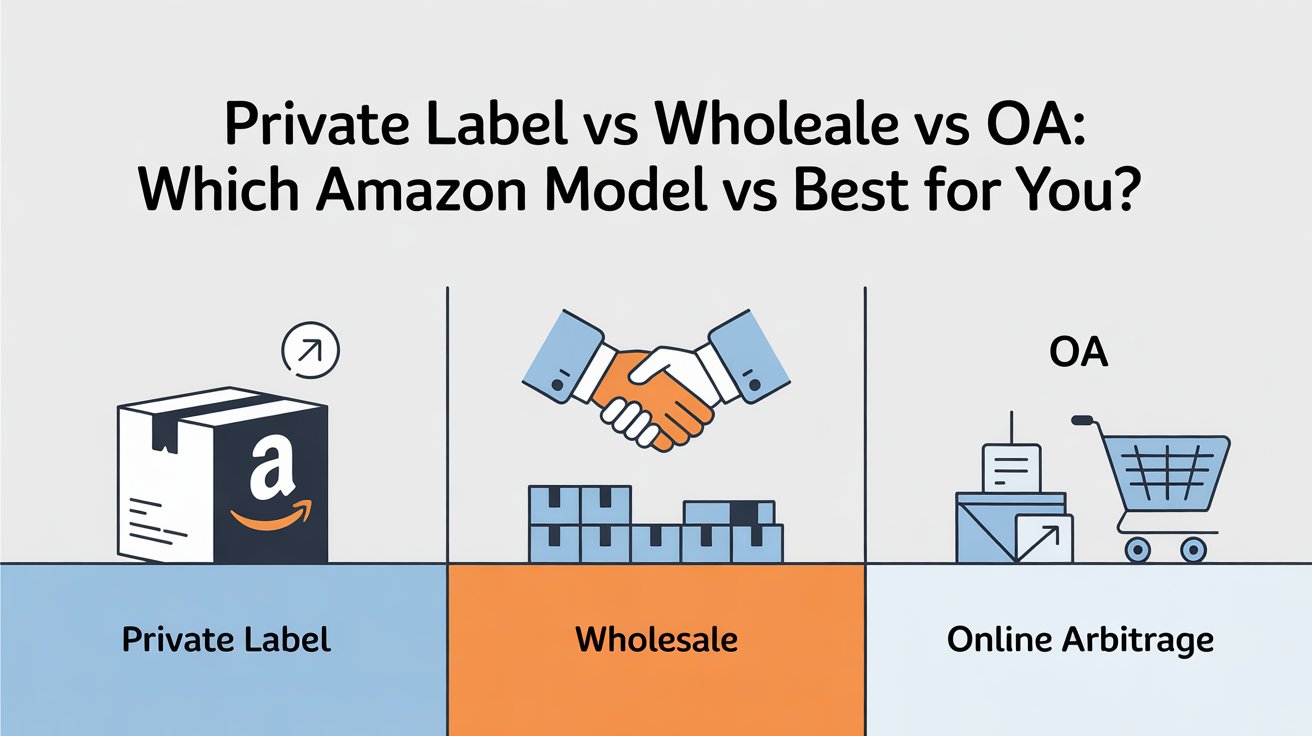
Choosing the wrong Amazon business type costs time, money, and focus. Many sellers quit not because the platform is too hard, but because they start with a model that doesn't fit their budget, risk comfort, or skill set. It’s like trying to run a marathon in flip-flops—you might have the energy, but your equipment is setting you up for failure.
If you feel confused by mixed advice or unclear profit paths, this guide walks you through a clear Amazon business models comparison. We’ll break down how to pick the right setup for your specific goals so you can start selling with confidence.
Why Your Choice of Model Defines Your Success
Every Amazon seller starts with different limits. One person might have $10,000 and zero time, while another has $500 and 40 hours a week to spare.
Using the wrong model for your situation leads to:
- Slow Sales: Picking a niche that is too competitive for your budget.
- Account Stress: Not understanding the specific rules for your business type.
- Cash Flow Blocks: Your money getting tied up in inventory that won't move.
Before spending a dollar, you need to match your resources to the right strategy.
Major Amazon Business Models at a Glance
| Feature | Private Label | Wholesale | Online Arbitrage (OA) |
| Startup Cost | Medium – High ($3k+) | Medium ($2k - $5k) | Low ($100 - $1k) |
| Brand Control | Full Ownership | None | None |
| Risk Level | Medium (Product Risk) | Low (Stable Demand) | Medium (Stock Fluctuations) |
| Scalability | Very High | Medium | Low |
1. Private Label: Building a Long-Term Brand
Private Label is the "gold standard" for sellers who want to build a real asset. You find a generic product, add your own branding and packaging, and list it as your own.
- How it works: You find a gap in the market, source from a factory, and use Amazon FBA to handle the logistics.
- Best Fit: Sellers with a budget of $3,000+ who want to own their listings and achieve the highest possible margins.
The Challenge: You have to create the demand. Unlike big brands, nobody is searching for your name yet.
The Solution: Use the Niche Finder and Keyword Research tools in 10xProfit.io. These tools show you exactly what people are searching for so you don't launch a product that nobody wants.
2. Wholesale: The Stable Cash Flow Path
Wholesale involves buying brand-name products (like LEGO or Dove) directly from authorized suppliers and reselling them on existing Amazon listings.
- How it works: You open accounts with distributors, buy in bulk, and share the "Buy Box" with other sellers.
- Best Fit: People who prefer lower risk and don't want to deal with manufacturing or logo design.
Practical Insight: The hardest part of Wholesale is the math. You need to know your exact profit after shipping and fees. The Amazon Profit Calculator inside 10xProfit handles this instantly, ensuring you never buy stock that results in a loss.
3. Online Arbitrage (OA): The Beginner’s Training Ground
OA is the process of buying discounted products from retail websites (like Walmart or Target) and reselling them on Amazon for a higher price.
- How it works: You "hunt" for price gaps between retail stores and Amazon.
- Best Fit: Beginners with limited cash who want to learn how the Amazon system works without a huge investment.
How to Scale: Finding "valid leads" manually takes forever. To speed this up, use the Amazon ASIN Lookup and Product Comparison features in 10xProfit. This allows you to scan products and see their sales history and competition levels in seconds.
The Role of Data in Choosing Your Model
No matter which Amazon business type you pick, your success depends on verified data. Many sellers fail because they use "gut feelings" instead of numbers.
Why 10xProfit.io is the "Swiss Army Knife" for Sellers
Whether you are doing Private Label or Wholesale, you need a system that minimizes your mistakes. 10xProfit.io offers 40+ pro tools designed to solve the most common seller problems:
- Budget Planning: Use the Amazon Budget Planner to see exactly how much you need for your chosen model.
- Product Validation: The Advanced Product Database helps you avoid high-risk items.
- Listing Mastery: If you choose Private Label, use the AI Title and Description Generators to rank faster in search results.
Which Model Should You Choose?
Choose Private Label if you want:
- To build an asset you can sell later.
- To have zero competition on your specific listing.
- High margins and full creative control.
Choose Wholesale if you want:
- A faster setup with proven products.
- Predictable, recurring sales.
- To avoid the "brand building" phase.
Choose Online Arbitrage if you want:
- To start with less than $1,000.
- To practice your sourcing skills.
- A low-risk way to test the e-commerce waters.
FAQs
1. Which Amazon model is the most profitable?
Private Label generally offers the highest profit margins because you control the price and there are no other sellers on your listing.
2. Is Online Arbitrage (OA) dead in 2026?
Not at all. However, it is more competitive. You need tools like 10xProfit to find leads that other people are missing.
3. Do I need an LLC to start?
For OA, you can start as an individual. For Wholesale and Private Label, an LLC is highly recommended to open professional supplier accounts.
4. How much money do I need for Wholesale?
Usually between $2,000 and $5,000 to place your first bulk orders and cover shipping/software costs.
5. Can I use FBA for all of these models?
Yes! Fulfillment by Amazon (FBA) is compatible with Private Label, Wholesale, and OA.
6. What is the safest model for a beginner?
Wholesale is often considered the safest because you are selling products that already have high demand.
7. How do I get "ungated" in restricted categories?
You usually need an invoice for 10+ units of a product from a verified distributor.
8. Why is 10xProfit better than other tools?
It provides an all-in-one solution. Instead of paying for five different subscriptions, you get 40+ tools (research, listing, marketing, and operations) in one place.
9. Can I do this from outside the US?
Yes. Amazon supports 18+ global marketplaces. You can use a Prep Center in the US to handle your physical products while you manage everything online.
10. How long before I see a profit?
Arbitrage can be profitable in 30 days. Private Label usually takes 3-6 months to see a real return as you build brand authority.
Final Thoughts: Focus Beats Confusion
Success on Amazon doesn't come from jumping between trends. It comes from choosing one path and mastering it with the right data.
- If you want to own the market, go Private Label.
- If you want to sell what works, go Wholesale.
- If you want to learn the ropes, go Arbitrage.
Whatever path you choose, don't do it blindly. Use a platform like 10xProfit.io to verify your leads, plan your budget, and scale your business to that $100K goal.