
Many sellers enter the marketplace with high hopes but little data. They see a product selling well and assume that a high sales volume automatically means a high bank balance. Unfortunately, without a proper Amazon profit forecasting before launch strategy, you might find yourself moving thousands of units while actually losing money.
The secret to a sustainable e-commerce business is simple: do the math before you spend a single dollar on inventory. If you wait until your product is in the warehouse to check your margins, you have already waited too long. This guide will walk you through the process of building a reliable financial map for your brand.
Why Profit Forecasting is Essential for Your Survival
Launching a product is expensive. Between manufacturing, international shipping, and the initial marketing push, you are putting a lot of capital at risk. A pre-launch Amazon profit analysis acts as your safety net. It allows you to see potential pitfalls before they become reality.
Accurate forecasting helps you:
- Set Realistic Goals: You will know exactly how many units you need to sell each month to cover your fixed costs.
- Secure Better Sourcing: When you know your target margin, you can negotiate with suppliers more effectively.
- Plan Your Ad Budget: You can determine your maximum cost-per-acquisition without going into the red.
- Manage Inventory Cycles: Understanding your profit per unit helps you decide how much to reinvest into your next order.
Review of Professional Forecasting Tools
In 2026, spreadsheets are no longer enough. The marketplace moves too fast, and fees change without much notice. Using a professional platform ensures your data is fresh and your projections are accurate.
1. Amazon Profit Calculator
This is the foundation of any forecast. It allows you to plug in your anticipated selling price and subtract every platform fee.
- Features: It supports multiple marketplaces and allows you to toggle between FBA and FBM models.
- Accuracy: It uses the most current fee schedules to ensure your Amazon product profit estimation is precise.
- Link: Amazon Profit Calculator
2. Amazon Budget Planner
Before you commit to a product, you need to know if you can afford the launch. This tool breaks down your costs by category and helps you stay within your limits.
- Features: Provides business model recommendations based on your available cash.
- Ease of Use: Highly intuitive, making it a great starting point for those new to the business.
- Link: Amazon Budget Planner
3. Shipping Cost Calculator
Logistics is the most volatile part of the supply chain. A dedicated calculator helps you project these costs across different shipping methods.
- Features: Accounts for dimensional weight and multi-marketplace estimates.
- Link: Shipping Cost Calculator
Step-by-Step Guide to Forecast Your Earnings
Follow this workflow for every new product idea you have. Consistency is the secret to avoiding bad investments.
1. Gather True Landed Costs
Don't just use the unit price from the factory. Ask your supplier for the exact weight and dimensions of the final packaging. Add in the cost of the master cartons, inspection fees, and the cost of getting the goods to an Amazon fulfillment center.
2. Apply Platform Fees
Use a FBA fee breakdown tool to find your category's referral fee and the fulfillment fee for your specific size tier. Don't forget monthly storage costs, which increase significantly during the holiday season.
3. Estimate Marketing and PPC Spend
Most products won't sell without advertising. A good rule of thumb for a new launch is to set aside 20% to 30% of your revenue for PPC. As your organic ranking improves, this percentage should drop.
4. Build Three Different Scenarios
A professional forecast should include:
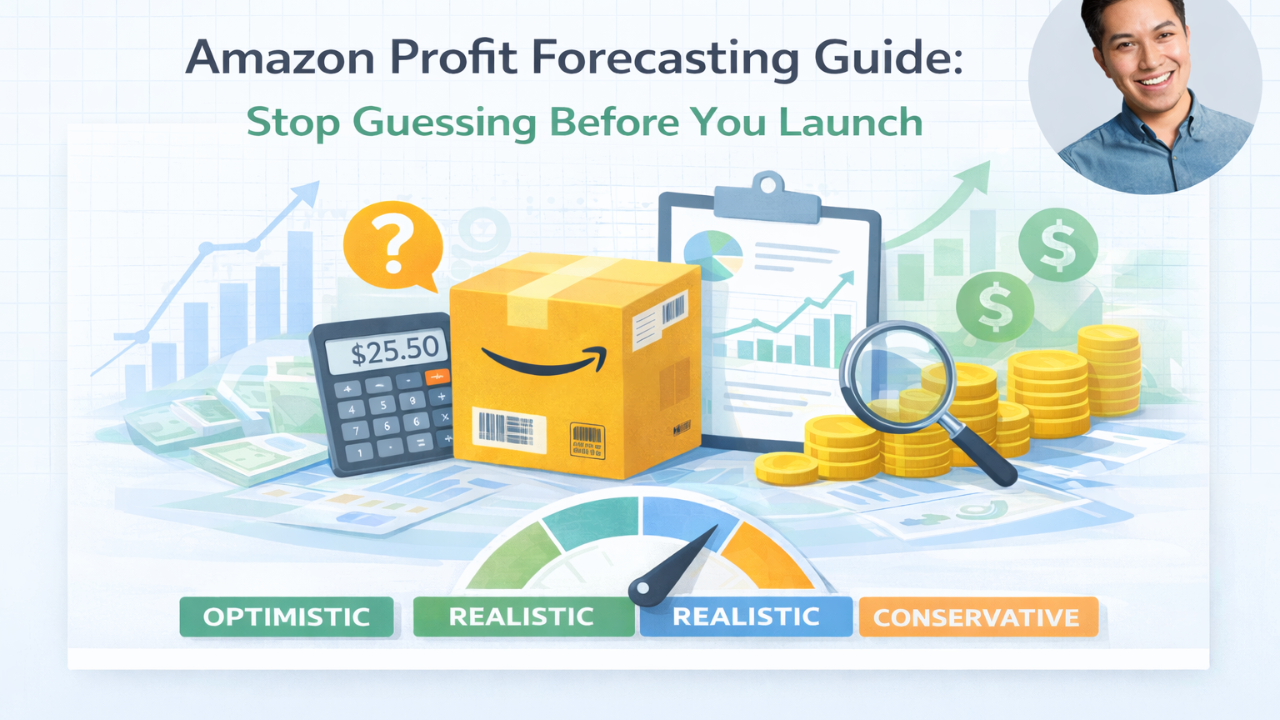
- The Optimistic View: High sales volume, low ad costs.
- The Realistic View: Average sales volume, steady ad costs.
- The Conservative View: Low sales volume, high competition, and high ad spend.
If your product is still profitable in the conservative view, it is a winner.
Practical Tips for Accurate Margins
- Factor in Returns: Depending on your category, 3% to 10% of customers will return your product. You still pay fees on these units.
- Watch the Size Tiers: A fraction of an inch can move you into a more expensive shipping bracket. Design your packaging to be as small as possible.
- Track Currency Fluctuations: If you source in one currency and sell in another, exchange rates can eat your profit.
- Use Historic Data: Look at market trends from the previous 12 months to see if prices drop during certain times of the year.
Comparison Table: FBA vs. FBM Profit Outlook
Choosing the right fulfillment method is a major part of your Amazon margin forecasting.
| Feature | FBA (Fulfillment by Amazon) | FBM (Fulfillment by Merchant) |
| Storage Cost | Charged per cubic foot | Your own warehouse/garage cost |
| Shipping Labor | Handled by Amazon | You pick, pack, and ship |
| Prime Eligibility | Automatic | Requires high performance metrics |
| Fee Structure | Fixed fulfillment fees | Variable shipping costs |
| Best For | Fast-moving, small items | Heavy, bulky, or slow-moving items |
Common Mistakes to Avoid
Overestimating Organic Sales
In the current marketplace, you cannot rely on organic search alone for a new launch. If your Amazon profit forecasting before launch does not include a heavy ad spend for the first 60 days, your forecast is not realistic.
Ignoring the "Long Tail" of Storage
If you buy 1,000 units and only sell 50 a month, your storage fees will eventually kill your profit. Always match your order volume to your projected sales velocity.
Forgetting About Tax Obligations
Different marketplaces have different VAT or Sales Tax rules. If you don't account for these, you are essentially giving away a large portion of your margin to the government.
Guessing Competitor Pricing
Don't just look at the current price. Use a competitor analysis tool to see if they frequently run deep discounts or coupons. If the market average is $25 but the leader often sells for $18, you need to be profitable at $18.
10 SEO-Focused FAQs
How do I forecast profit for a new Amazon product?
Start with your landed cost, add Amazon referral and fulfillment fees, subtract your estimated PPC spend per unit, and factor in a return rate.
What is a good profit margin for Amazon FBA?
A net profit margin between 20% and 30% is considered healthy for most private label products.
How much should I spend on PPC for a launch?
Expect to spend 30% to 50% of your revenue on ads during the first month. This should stabilize to 10-15% as you gain organic rankings.
Does the Amazon profit calculator include taxes?
Most calculators allow you to manually enter a tax rate based on your specific location and marketplace rules.
How do I estimate my shipping costs?
Use a shipping cost calculator that factors in both actual weight and dimensional weight for ocean and air freight.
Why is ROI more important than profit margin?
ROI shows how effectively you are using your capital. A high ROI means you can grow your business faster with less money.
How often should I update my profit forecast?
You should review your numbers at least once a month, especially after any platform fee updates or changes in your supplier pricing.
What is a referral fee?
It is the commission Amazon charges for every sale, typically ranging from 8% to 15% depending on the category.
Can I be profitable with a $15 product?
It is difficult because fulfillment fees take up a large percentage of the price. Products priced between $25 and $70 usually have better margins.
How do I find the best products to sell?
Use a product research tool to find items with high demand and low competition scores.
Secure Your Success with Data
The era of "launch and pray" is over. To build a brand that lasts, you must treat your numbers with respect. By using a professional Amazon profit forecasting before launch approach, you take control of your financial destiny.
Don't let hidden fees or unexpected shipping costs sink your business. Use the tools, do the research, and only launch when the data says "yes."